WASHINGTON—The deadline for comments on the U.S. Department of Agriculture’s (USDA) proposed new comprehensive rules for Nutrition Standards in the National School Lunch and School Breakfast Programs is April 13, 2011.
The new rules would align school meals with the Dietary Guidelines for Americans (DGAs) and require schools to serve healthier school meals, including more fruits, vegetables, whole grains, fat free/low-fat milk, and less sodium and saturated fat.
One of the biggest changes for school breakfast would be to double the amount of fruit to 1 cup per day. The greatest change for school lunch would be an increase in fruits and vegetables to nearly four servings a week.
USDA also is seeking comments on ways to incorporate the 2010 Dietary Guidelines into the proposed updated nutrition standards for school meals, which were based on 2005 DGAs. The 2010 DGAs include a new red-orange vegetable subgroup, while the proposed meal patterns include an orange vegetable subgroup and group the red vegetables under the category of other vegetables (consistent with the 2005 DGAs). The proposed meal patterns do reflect the emphasis on consuming a variety of vegetables, which is a key recommendation of the 2005 and 2010 DGAs.
The 2010 DGAs also advise consuming protein from a variety of sources, and recommend weekly
amounts from three protein foods subgroups—seafood; meat, poultry and eggs; and nuts, seeds and soy products. The proposed meal patterns contain weekly and daily amounts of meats/meat alternates, but do not specify amounts for subgroups introduced by the 2010 DGAs.
Commenting on the proposed rules, United Fresh said it supports these elements of the proposed rule, but opposes one significant provision in the proposal that limits starchy vegetables, including white potatoes, corn and peas. That proposal is not aligned with the Dietary Guidelines, and inappropriately restricts a healthy vegetable.
- Press Release from www.foodproductdesign.com

Sunday, April 10, 2011


Thursday, April 7, 2011
Is it Okay to Eliminate Lunch from the School Day?
We all know that school district's across the country are making budget cuts. But as they cut programs and shorten the school year, we have to ask ourselves whether some things are worth saving. Below is an excerpt from an article about a district in Ohio that is considering eliminating school lunch, among other things. What are your thoughts? Do you think school lunch is a necessary part of the school day, or is it something we can drop entirely?
LANCASTER -- One of the proposed cuts the Amanda-Clearcreek Board of Education has floated in the past couple of weeks in a spending reduction plan does not have much community support -- shortening the school day and eliminating school lunches.
LANCASTER -- One of the proposed cuts the Amanda-Clearcreek Board of Education has floated in the past couple of weeks in a spending reduction plan does not have much community support -- shortening the school day and eliminating school lunches.
Laura Julian, who has three children attending Amanda schools, said she didn't think much of the idea.
"My kids are definitely going to to get a lunch, if they have to bring it to school," Julian said. "When one of the my kids told me about the proposal, I thought she had it wrong. But let's hope the school levy passes this time and it doesn't become an issue."
The district has been working on the spending reduction plan for weeks and will have another work session Friday night before voting on the final spending reduction plan.
During the meeting Monday, Board President Patricia Williard explained that, if the district's five-year, 1.5 percent earned income tax levy failed in May and the board followed through with its proposed plan to cut staff members and shorten the school day, lunch no longer would be provided to the students.
Monday night, the decision on spending reductions was delayed primarily because of the lunch debate.
The reduction plan is designed to address state cuts introduced last week in Gov. John Kasich's budget plan. Under the state plan, the overall education budget would see an 11.5 percent decrease in the first year and a 4.9 percent decrease the second year that includes the loss of federal stimulus dollars.
During a special board meeting, the board slightly revised its spending reduction plan to reflect an 11.5 percent decrease.
Among the board's recommended spending reductions ... the school day would be shortened to five-and-a-half hours for all grades, resulting in the elimination of three custodial positions, and lunch...
However, the elimination of the school lunch seems to have parents and relatives of children uniformed in their opposition.
Carolyn Sheets, a grandmother of two attending Amanda schools, said she didn't support the elimination of lunches.
"The kids really need their lunch," Sheets said. "I volunteer at the school and the kids start talking about lunch about a half hour before they go. It's pretty important to some of them."
John Anderson, who has a great-nephew attending Amanda schools, said the idea was "ridiculous."
"We got everyone telling us how important nutrition is and getting your meals," Anderson said. "I don't think it makes any sense."
To read more, click here.Monday, April 4, 2011
One Journalist's Experience with School Lunch - The Same Tired Excuses
Below is the second half of Julia O'Malley's story on school lunch in the Anchorage School District. This sad state of school lunch is almost identical to what is being offered in school districts across the country. As you'll read below, food-service officials offer the same tired excuses for why healthy food just doesn't work for school lunch. But we at Organic Fresh Fingers know that there is a way to make healthy, natural, local and organic lunch both affordable and attractive to students. We've shown time and time again a 20% increase in school lunch participation after making the change to our Fresh n' Local lunch program. Kids want to eat healthier - they're just not being given the choice!
The old-school lunch lady with her steaming fresh-baked trays has gone extinct. School lunch arrives at Anchorage schools wrapped in plastic. In school kitchens across the city, there isn't very much to mix, bake or boil. This is the era of reheating.
School lunch prep is centralized. It happens in a big Anchorage School District kitchen facility off Huffman Road. Many items come to the building -- Tater Tots, corn dogs, burger patties -- already processed. The facility processes them again, parceling them out into individual packages.
I visited the lunch facility recently and met Deb Stromstad, one of the district's student nutrition coordinators. She took me on a tour through the big kitchen, by the conveyor belt where workers were packing tots into containers and the huge oven where trays of rolls are baked. I peered into great big bowl of blue Jell-O.
Stromstad has been in the school nutrition business 15 years. I told her about eating lunch with high school students, and how some of them seemed to be eating French fries and pizza every day. It wasn't very healthy, I said.
"It's terrible," she said. "But that's what they go for."
The district meets government requirements and does its best to put healthy choices in front of students every day, she said.
"I can't force them to eat it," she said.
LUNCH FOR 24,000
Anchorage's school-lunch program is paid for partly by federal government reimbursement and partly by revenue from lunch sales. It serves roughly the population of a small city: 20,000 to 24,000 students daily. The district's average cost of each lunch: $4.63. Students who aren't low income pay between $3.15 and $4. The district's food operation has to "float its own boat," Stromstad explained. It runs on a tight margin and if it goes in the red, the people in charge have to ask the School District for money. Nobody wants to do that. So, it's essential to sell what students will buy.
I asked Stromstad what the most popular menu items are for high school students. Pizza, burritos, taco salads, burgers, Subway sandwiches, she said. Some items are healthier than others, but everything looks like something you can buy at a fast food restaurant. That wasn't necessarily the goal, but it is what sells.
Healthy menu items don't fly, she said. Baked potato bars. Salad bars. Soups. All fell flat. Once, years ago, the district tried kiwi fruit. It is both expensive and delicious. Lots of students threw it away. They didn't know what it was, she said. Waste is a big concern, too, she said. For that reason the district offers food, rather than serving it to every student. That's also why it sells food people know students will eat.
The issue isn't what the district serves, Stromstad, said, it's the culture we live in that pushes unhealthy food. The district's food program can't be expected to change the world. Student Nutrition is just in the business of serving breakfast and lunch.
"We're expected to try, so we try," she said.
We walked through a huge freezer filled with processed, frozen foods. The district has an allotted amount to spend with the U.S. Department of Agriculture every year on USDA lunch items. Brent Rock, who runs the student nutrition program, told me later that many of the items come from surplus food the government buys from farmers as part of government support for agriculture.
But school lunch is about to change. The federal government is considering guidelines that would add dark green and orange vegetables to the requirements. They would be served to students rather than offered. It would also move potatoes, French-fried or otherwise, out of the vegetable category. And it would finally place a limit on salt, with a goal to reduce the amount in foods by half over time. That will dictate some recipe changes for what is coming through USDA.
It will also cost more money locally, 27 to 34 percent more than the district is currently paying per meal. Where would that come from? The answer hasn't been worked out completely. The people who run Student Nutrition haven't figured out how they are going to get the students to actually eat healthier foods. Stromstad said they will try to sell students on sweet potato fries and they might puree some beans to add to breakfast bars.
A PROCESSED PROBLEM
Karol Fink, a dietitian with the state Department of Health, doesn't buy that students don't want healthier food. Their tastes are shaped by what is put in front of them, she said. Studies show kids can learn to eat healthy food just like they learn to like the taste of salty, sweet and fatty foods, she said. Schools are part of that learning process, especially for the nearly 40 percent of district students on the free or reduced lunch plan. For those students, schools provide both breakfast and lunch every day, often more than what's being provided at home.
It's not that students need to be eating only carrot sticks, Fink explained. The problem, she thinks, is when the schools rely so heavily on salty, higher-fat processed food that looks like fast food. Even making more meals that seem like what students might eat at home would be a start, she said.
"It would be nice if they could approximate actual food," she said.
There have been studies suggesting schools can get results just by placing less healthy foods in less visible spots, or by making dessert cash-only. Just asking, "Do you want a salad with that?" raised salad consumption 30 percent in one study. There is also the issue of education. Because of economics, of family practices or culture, some students have just not been exposed to healthy foods. Trying food from an early age is key, Fink said. She thinks the school district should have a dietician in the nutrition department.
Right now, students learn about nutrition in elementary and middle school, but often it's in the abstract. An elementary school teacher might do a unit on the food pyramid using plastic broccoli, for example, but some of the students may have never tasted it.
Schools in some places have some success with garden or farm field-trip programs where students learn where food comes from. Some districts even include "farmer trading cards" that tell students who grew their food. These have all proven to encourage healthy eating.
Students have to make the connection between what they are learning about nutrition and what they are actually eating at lunch. Sharon Vaissiere, head of the district's health curriculum, agreed the district could do a better job with that, especially with collaboration from Student Nutrition.
"There is a big disconnect between the nutrition we're teaching in the classroom and what happens when they go into the cafeteria," she said.
By high school, when students are at the height of body image consciousness and would be ripe for nutrition education, it isn't required.
Wednesday, March 30, 2011
One Journalist's Experience with School Lunch
Julia O'Malley, a reporter for the Anchorage Daily News, just wrote a two-part story of the state of school lunch in the Anchorage School District. The Anchorage School District is a great example of a standard school district's take on lunch across the country.
In the first part of her story, Julia went to a high school, ate the school lunch being served that day, and took notes of what the students were eating - whether they are school lunch, brought something from home, bought fast food off-campus, or ate from the school's vending machines or snack stand. She then worked with a dietitian to analyze the nutritional information for each lunch option. Here's what she learned:
"I had lunch at Dimond High School... I weighed my options with an adult eye for nutrition. Hot dog (salty). Soft taco (mystery meat factor high). French fries (par-fried, reheated). Pizza (greasy). Burrito.
In the first part of her story, Julia went to a high school, ate the school lunch being served that day, and took notes of what the students were eating - whether they are school lunch, brought something from home, bought fast food off-campus, or ate from the school's vending machines or snack stand. She then worked with a dietitian to analyze the nutritional information for each lunch option. Here's what she learned:
"I had lunch at Dimond High School... I weighed my options with an adult eye for nutrition. Hot dog (salty). Soft taco (mystery meat factor high). French fries (par-fried, reheated). Pizza (greasy). Burrito.
OK, burrito. Beans. Cheese. Tortilla.
HOW BAD COULD IT BE?
Later, I took pictures I'd taken of student lunches to Karol Fink, a dietitian with the state, to see what the food looked like nutrition-wise.
Before I met with Fink, I looked up some of the fast food kids were eating. I assumed it would be the worst, so it could function as a baseline. The 10-piece chicken nuggets, medium fries and Coke from McDonald's I saw a very slender girl eating? That packed more than half a day's calories (1,050), three-quarters of daily fat intake (48 grams, or equal to about half a stick of butter), more than half the recommended daily allowance of salt (1,270 milligrams or about half a teaspoon) and 58 grams of sugar, or about 14.5 sugar cubes. The double slice of pizza and Crush? In the neighborhood of 600 to 800 calories, 25 to 30 grams of fat, about 1,600 milligrams of sodium (more than McDonald's!) and 39 grams of sugar.
Fink and I started with food that wasn't part of the school lunch program. From the school store, we looked at the smoothie. It was high in Vitamin C, but the sugar content was extra high: 49 grams. That's more than a regular soda (which the district no longer allows to be sold in schools ). The Cup-o-Noodles wasn't fantastic in the fat department (14 grams), but the bigger problem was the salt: 1,434 milligrams. That, too, was more than the entire McDonald's meal.
The lunches that came from home tended to be relatively decent. Here's one Fink liked: peanut butter and jelly on wheat bread. Around 300 or 400 calories, about 14 grams of fat and 10 grams of protein. Add in a 200-calorie low-fat yogurt cup, 90-calorie granola bar, a small 150-calorie bag of potato chips, 100-calorie juice box, and a pear, you get about 900 to 1,000 calories. That's a lot of calories, but less than 30 percent comes from fat, overall it isn't high in salt and it has calcium, protein and fiber. And, it wasn't all highly processed food. Fink would probably trade out the chips for pretzels or pita chips to make it healthier.
Then we got to the district's school lunch options. What we found surprised us both. For one thing, the nutrition information provided by the district had missing pieces and wrong numbers. We did our best with what we could find and used estimates to fill in the holes.
The popular pizza, available daily to high school students, has been billed as a healthier option than previous pizza the district served. (Students at Dimond complained that the taste suffered because of that.) But when we compared it with fast food pizza, we found it had about the same number of calories per slice (340) and a similar amount of fat (13 grams on the pepperoni). Salt was somewhat lower, thought not terrific, at 590 milligrams per slice.
THE STANDARDS
On the school lunch menu, the pizza is often paired with other optional items: a piece of fresh fruit, milk and par-fried potato products, either fries or tots. (According to the U.S. Department of Agriculture, fried potatoes count as a vegetable.) In high school, everything is a la carte, so students can choose to have pizza every day.
The fries are salty but not terrible (159 calories, 6 grams fat and 439 milligrams of salt), but the tots are another story. They have 226 calories, 13 grams fat, and 450 milligrams of salt. Taken together with pizza, that's a lot of fat and close to the amount of salt in the McDonald's meal. Chocolate milk isn't too bad, adding a little protein and calcium and another 12 grams of sugar.
My burrito? Three-hundred and 10 calories, 10 grams of fat and 640 milligrams of sodium. The best choice would have been a veggie Subway sandwich (230 calories, 2.5 grams fat, 400 milligrams sodium). Surprisingly, the other Subway options, though lower in fat, have a ton of salt. A 6-inch ham sub packs nearly as much (1,200 milligrams) as the entire McDonald's meal.
District meals have to meet a lot of requirements set out by the government, but they don't have to meet nutrition standards every day. Instead they have to meet a weekly standard. Here's what they're going for: 30 percent of calories or less from fat, 10 percent from saturated fat and no more than 30 grams sugar every day. There is no federal sodium standard. The state standard for sodium, also measured on a weekly basis, is 1,650 milligrams on average, per day. That's a lot for lunch, considering the recommended amount for an entire day is no more than 2300 milligrams.
"When you're taking foods and breaking them down that way, you can make a lot of things meet the requirement," Fink said.
In high school, where students have the most choice, they can forgo the healthiest part of the lunch altogether and they can choose to eat the same thing every day. That means their meals don't meet any standards.
If some of the students keep eating the way they eat now, they can expect increased risk of heart disease and obesity. Sodium at the levels the students have become used to increases the risk of stroke and heart disease.
Fink's overall reaction to what students are having for lunch?
"Yikes."
Yikes is right. That's why Organic Fresh Fingers was founded - to provide a healthy, fresh, and local alternative to the unhealthy school lunches that are currently being served every day across the country.
Up Next: the second part of Julia's story, where she discusses why school lunch can't be healthier with the district's nutrition services.
To see photos of lunches from Dimond High School with individual calorie counts, click here.
Thursday, March 24, 2011
An Extra $158 Million for Fresh Fruits & Veggies
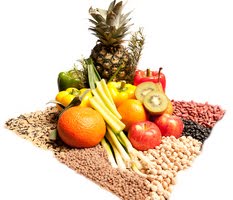 Under the USDA's new guidelines for the National Lunch Program, schools are expected to increase the amount of fresh fruits and vegetables they serve. Recently, the USDA announced that it would be putting its money where its mouth is: The USDA will put $158 million into the Fresh Fruit and Vegetable Program this year that will go to schools across the country.
The FFVP program works to provide free fresh fruits and vegetables to school children throughout the day. In order to receive the funds from the state, schools must make certain each child receives between $50 - $75 worth of fresh fruits and vegetables throughout the year. The USDA estimates that the FFVP program will be able to include an additional 600,000 - 950,000 children this year.
Oregon will receive $2,528,331 for the FFVP. The state will administer the program, distributing funds to schools that continue working to improve the health and nutrition of the foods they serve.
Organic Fresh Fingers' lunches always include a fresh, organic fruit and vegetable. We think it's wonderful that the government is stepping up to bridge the budget shortfall and help schools make a change for the better. To find out more about the program, see the USDA's press release.
Tuesday, March 22, 2011
Marion County's "I Love ME" Program
Today, on the steps of the state Capitol, Marion County officially launched it's "I Love ME" campaign to fight obesity and diabetes in the county. Senators Peter Courtney and Jackie Winters, together with other key community members, have joined forces to raise awareness and turn Marion County into a healthier place.
For all of our state's reputation for local, healthy foods and outdoor activities, obesity and diabetes are severe problems in Oregon, just as they are across the nation.
Perhaps this will be the year we can all agree that it is time to stand together and demand something better.
For all of our state's reputation for local, healthy foods and outdoor activities, obesity and diabetes are severe problems in Oregon, just as they are across the nation.
"In a 2009 report to lawmakers, the Office of Oregon Health Policy and Research said:
-One in four eighth-graders was overweight.
-Nearly one in three 11th-graders had weight problems.
-Six in 10 adults were overweight or obese.
-One in three adults has high cholesterol, a key risk factor for heart disease.
The diabetes death rate has increased 76.5 percent since 1990. Yet Oregonians are doing little to help themselves. Large percentages don't regularly exercise or eat vegetables and fruits." - www.statesmanjournal.com, Join 'I Love Me' initiative and fight obesity
Perhaps this will be the year we can all agree that it is time to stand together and demand something better.
Tuesday, March 15, 2011
More Kids Qualify for Free or Reduced School Lunch
In school districts across the country, more and more children are qualifying for free or reduced school lunch. This is most likely due to the recent recession in the country, with more people unemployed or making reduced wages. It's excellent that the government has a program that protects children during their most crucial development years. The fact that more children are qualifying for the lunch program creates a more urgent need to reform the quality of school lunch.
It's been our experience that kids who qualify for free or reduced lunch are the majority of kids participating in the school lunch program. Those who can afford to bring lunches from home. This creates a micro-social class system in every school. The "poor" kids eat lunch at school and they have no option but to eat the processed, calorie and sodium-laden food that is served every day, while the "well-off" kids bring healthy, fresh lunches from home. This system not only hurts the school district financially, but also hurts those children who need our help and attention the most.
Organic Fresh Fingers is committed to making sure every child, no matter their socio-economic status, has access to a fresh, nutritious and delicious school lunch. In fact, we've found in our schools that when our Fresh n' Local lunch program is served, participation of children who do not qualify for free or reduced lunch rises almost immediately by at least 20%. This helps the school have a more sustainable and profitable lunch program, as well as creating an atmosphere where all children enjoy the lunch meal together.
It's been our experience that kids who qualify for free or reduced lunch are the majority of kids participating in the school lunch program. Those who can afford to bring lunches from home. This creates a micro-social class system in every school. The "poor" kids eat lunch at school and they have no option but to eat the processed, calorie and sodium-laden food that is served every day, while the "well-off" kids bring healthy, fresh lunches from home. This system not only hurts the school district financially, but also hurts those children who need our help and attention the most.
Organic Fresh Fingers is committed to making sure every child, no matter their socio-economic status, has access to a fresh, nutritious and delicious school lunch. In fact, we've found in our schools that when our Fresh n' Local lunch program is served, participation of children who do not qualify for free or reduced lunch rises almost immediately by at least 20%. This helps the school have a more sustainable and profitable lunch program, as well as creating an atmosphere where all children enjoy the lunch meal together.
Subscribe to:
Posts (Atom)